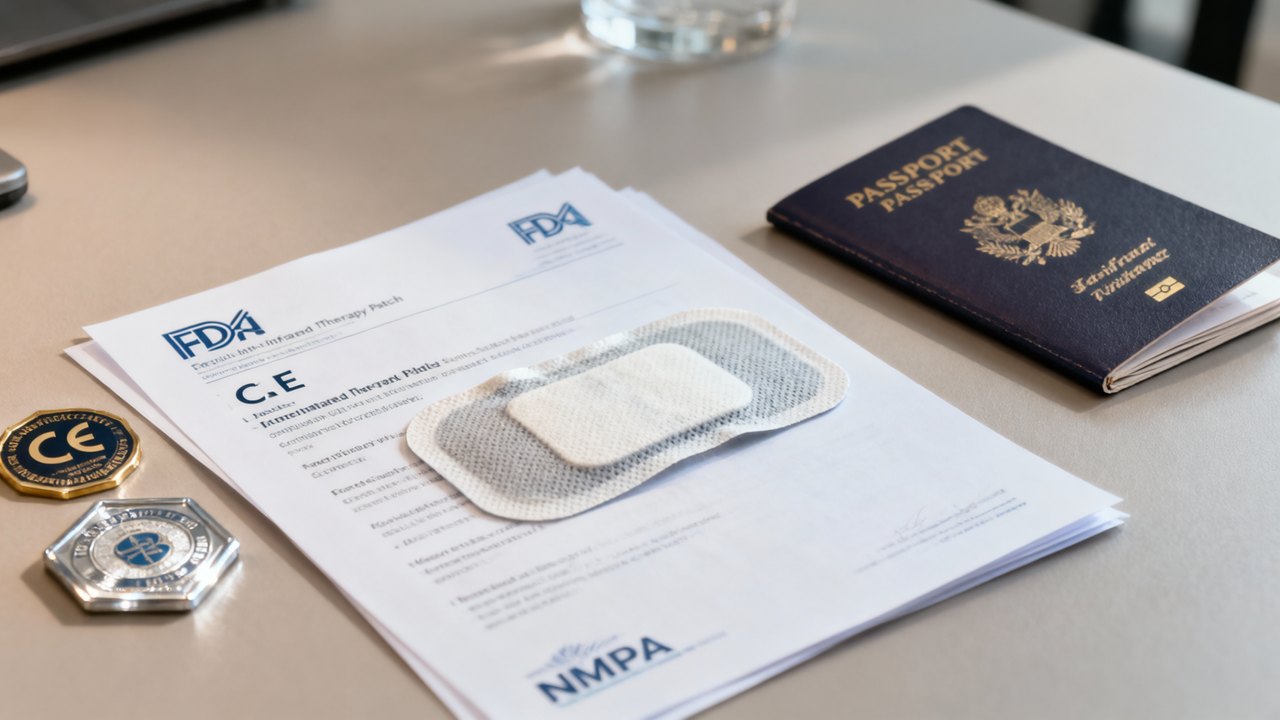
For distributors seeking to import far-infrared therapy patches into international markets, understanding the regulatory landscape across FDA (US), CE (EU), and NMPA (China) is essential. Each jurisdiction has distinct classification, registration, and compliance requirements that directly impact your market entry timeline and cost.
Why Regulatory Comparison Matters
Far-infrared therapy patches sit at the intersection of wellness and medical device regulation. Depending on the target market, the same product may be classified as a medical device, a wellness product, or a general consumer good — each with vastly different compliance requirements.
Strategic implication: Your NMPA Class II registration in China does not automatically grant market access in the US or EU. However, it provides a strong regulatory foundation that can accelerate registrations in other jurisdictions.
NMPA (China) — Our Existing Foundation
Classification
Far-infrared therapy patches are regulated as Class II medical devices under NMPA.
Our Registration
- Registration number: 鄂械注准 20252095452
- Validity: 2025-03-17 to 2030-03-16
- Scope: Promotes local blood circulation, auxiliary anti-inflammatory, swelling reduction, and pain relief
Requirements Met
- Clinical efficacy data submission
- Biocompatibility testing (ISO 10993 series)
- Class 100K cleanroom manufacturing
- Full QMS compliance (equivalent to ISO 13485)
- Post-market surveillance system
Advantage for Overseas Buyers
Our NMPA registration demonstrates that our products meet Chinese medical device standards — among the most rigorous in the world. This provides the quality documentation foundation needed to pursue registrations in other markets.
FDA (United States)
Classification Pathway
Far-infrared therapy patches typically fall under one of two pathways:
Option A: 510(k) Premarket Notification
- Required if the product makes medical claims (pain relief, circulation improvement)
- Requires a predicate device comparison
- Typical timeline: 6-12 months
- Cost: $10,000-$50,000 (excluding testing)
Option B: Consumer Wellness Product (No FDA Registration)
- If marketed as a general wellness/warming product without medical claims
- No FDA premarket review required
- Limitation: Cannot make therapeutic claims on packaging or marketing
- Advantage: Fastest, lowest-cost market entry
Key FDA Requirements (510(k) Pathway)
- Substantial equivalence — Demonstrate equivalence to a legally marketed predicate
- Biocompatibility testing — ISO 10993 skin irritation and sensitization tests
- Clinical data — May be required depending on claims
- Quality System Regulation (21 CFR 820) — Full QMS compliance
- Establishment Registration — Factory registration with FDA
- Device Listing — Product-specific listing
Strategic Recommendation
For fastest US market entry, launch as a consumer wellness product first (no medical claims), then pursue 510(k) clearance once market traction validates demand.
CE Mark (European Union)
Classification
Under the EU Medical Device Regulation (MDR 2017/745), far-infrared patches are typically Class IIa devices.
Requirements
- Conformity assessment — Via Notified Body (third-party review)
- Technical documentation — Full technical file per MDR Annex II
- Clinical evaluation — Clinical data demonstrating safety and performance
- Risk management — ISO 14971 risk analysis
- QMS certification — ISO 13485 via Notified Body audit
- Post-market surveillance — Periodic safety update reports
Timeline and Cost
- Typical timeline: 12-18 months (MDR has significantly slowed approvals)
- Notified Body cost: €15,000-€40,000
- Testing cost: €5,000-€15,000
Advantage
A CE mark allows free movement across all 27 EU member states plus EEA countries. It is the most valuable single registration for European market access.
Comparison Summary
| Aspect | NMPA (China) | FDA 510(k) (US) | CE MDR (EU) |
|---|---|---|---|
| Device class | Class II | Class II (typically) | Class IIa |
| Review body | NMPA | FDA | Notified Body |
| Typical timeline | Already registered | 6-12 months | 12-18 months |
| Clinical data | Required | Likely required | Required |
| QMS standard | Chinese QMS | 21 CFR 820 | ISO 13485 |
| Factory inspection | Yes | Possible | Yes (Notified Body) |
| Post-market surveillance | Required | Required | Required |
Recommended Market Entry Strategy
Phase 1: Start with markets that don’t require medical device registration
Markets where far-infrared patches can be sold as wellness products:
- ASEAN countries — Many accept Chinese NMPA registration directly
- Middle East — Growing wellness market with flexible entry
- Latin America — Brazil, Mexico have simplified wellness product pathways
- Africa — Emerging markets with lower regulatory barriers
Phase 2: Pursue CE Mark for EU
The EU MDR process is the most internationally recognized medical device certification. Once obtained, it facilitates registrations in many other markets that recognize CE.
Phase 3: Pursue FDA 510(k) for US
The US market is the largest but also the most complex. Enter only after establishing revenue in other markets to fund the regulatory investment.
How We Support Your Registration
Our existing NMPA Class II registration provides:
- Full technical documentation — Ready to adapt for FDA/CE submissions
- Clinical efficacy data — NMPA-accepted clinical study results
- Biocompatibility test reports — ISO 10993 series results
- QMS documentation — Comprehensive quality management system records
- Manufacturing facility audit — Cleanroom certification and inspection records
Our OEM team works directly with your regulatory consultants to provide all necessary documentation for your target market registration.